🛈 As an Amazon Associate, CeraVelas earns from qualifying purchases. If you buy through our links, Amazon pays us a small commission at no extra cost to you. That’s how we keep the site running. How we choose.
📑 Contents
⚡ Our top picks: cD wicks
Stock checked on October 6, 2026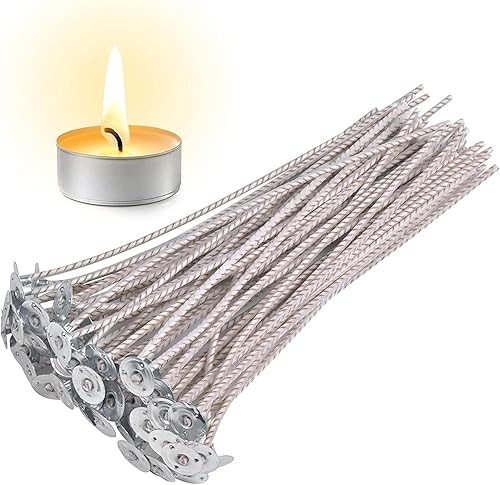
Best cD wicks in stock
CD Series Candle Wicks for Soy Candles,100pcs CD 12 6" Pretabbed Wicks,Cotton & Paper Wicks for Candle Making…
CD Series Candle Wicks for Soy Candles,100pcs CD 18 6" Pretabbed Wicks,Cotton & Paper Wicks for Candle…
100 Piece CD8 Candle Wick 6" Pre-Waxed for Candle Making,Candle DIY
100pcs CD 20 Wicks for Soy Candles, 6 inch Pre-Waxed Candle Wick with Base
100pcs CD 2 Wicks for Soy Candles, 6 inch Pre-Waxed Candle Wick with Base
100pcs CD 4 Wicks for Soy Candles, 6 inch Pre-Waxed Candle Wick with Base
CeraVelas score: combines the average rating and the number of customer reviews on Amazon.
What CD wicks are
The CD series is a coreless, flat-braided cotton wick with a thin paper thread woven in for a bit of stiffness. As it burns, the tip curls toward the outer edge of the flame, where it’s hottest, and is consumed there. That’s why they are called self-trimming: they mushroom very little and the flame stays steady for hours.
Compared to other flat series, CD wicks tend to burn a little hotter at the same number. That makes them a good fit for dense waxes like soy wax, for jars where the melt pool struggles to reach the edge, and for formulas with a generous fragrance load. They also work very well in paraffin, where you can often go down a size.
Available sizes
The usual range runs from CD 3 to CD 22, typically in steps of one in the small sizes (CD 3, 4, 5, 6, 7, 8) and steps of two in the larger ones (CD 10, 12, 14, 16, 18, 20, 22). The higher the number, the thicker the wick and the more wax it burns. Sizes above CD 16 are mostly for very wide vessels or outdoor candles.
How to choose a size
As with any wick, start with the inside diameter of the jar and adjust for wax and fragrance. The chart shows typical starting points for soy wax; you can cross-check them with the wick calculator.
| Jar diameter | Starting CD size (soy) | With paraffin (approx.) |
|---|---|---|
| 2 in (5 cm) | CD 4 | CD 3 |
| 2.4 in (6 cm) | CD 6 | CD 5 |
| 2.75 in (7 cm) | CD 8 | CD 7 |
| 3.1 in (8 cm) | CD 10 | CD 8 |
| 3.5 in (9 cm) | CD 12 | CD 10 |
| 4 in (10 cm) | CD 14 | CD 12 |
| 4.3–4.7 in (11–12 cm) | 2 × CD 7–8 | 2 × CD 5–6 |
Keep in mind these are starting points. A fragrance heavy in base notes, a strong dye or a narrow-mouth jar may call for a different size. With coconut wax, which melts easily, one size down is often enough.
How to use them
- Secure the metal tab in the center of the jar with a wick sticker.
- Keep the wick taut and centered with a centering device while you pour and while the wax cools.
- Let the candle cure: with soy, one to two weeks makes a big difference in scent throw.
- Trim the wick to about 1/4 inch (5–6 mm) before the first burn.
- During the test burn, check at hours 1, 2, 3 and 4: melt pool width, flame height, smoke and glass temperature.
Common mistakes
- Using the same number as an ECO wick. The numbering doesn’t match; a CD 8 is not an ECO 8.
- Going big "just in case." An oversized CD wick means a tall flame, soot and dangerously hot glass.
- Ignoring mushrooming. Heavy carbon buildup means the wick is too big: drop a size.
- Testing only once. Ideally, run several 3–4 hour burns across the life of the candle.
- Leaving candles burning unattended or near drafts.
To compare series, also check out ECO wicks and HTP wicks, and read our guide to choosing a wick.
Pros and cons
👍 Pros
- ✓ Steady flame that partly self-trims
- ✓ A bit more power than other flat series
- ✓ Good performance in soy and paraffin
- ✓ Wide range of sizes
👎 Cons
- ✗ Easy to oversize and get soot
- ✗ Numbering differs from other series
- ✗ Can be too much for very soft waxes
- ✗ Need testing for every new formula
How to use cD wicks, step by step
- Measure the inside diameter of the jar.
- Pick a starting CD size for your wax.
- Stick the tab in the center and center the wick.
- Pour and let it cure.
- Trim to 1/4 inch and run a 3–4 hour test burn.
- Adjust one size up or down based on the results.
Tips
- Test three consecutive sizes at once in identical jars.
- Note the time when the melt pool reaches the edge.
- If the glass is too hot to touch near the top, the wick is too big.
- Store wicks in a sealed bag, away from dust and humidity.
Related supplies
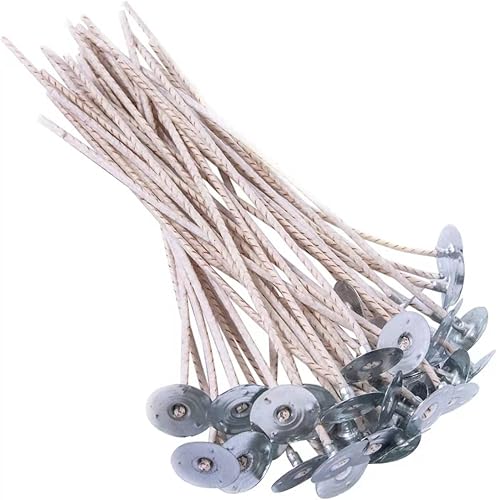
 🧵 Wicks Cotton candle wicks Pre-tabbed, pre-waxed cotton wicks are where almost every homemade candle starts: inexpensive, reliable and available in dozens of sizes. See guide →
  🌱 Wicks ECO wicks ECO wicks are one of the most popular series for natural wax candles: they burn clean, curl on their own and mushroom very little. See guide →
  🔥 Wicks HTP wicks HTP wicks are built for thick natural waxes and heavily scented formulas: a strong, steady flame, little soot and great ability to draw wax up. See guide →
  🫘 Waxes Soy wax Soy wax is the go-to natural wax for container candles: creamy, beginner-friendly and known for a slow, clean burn. See guide →
  🕯️ Waxes Paraffin wax Paraffin wax is the most versatile and affordable candle wax: it takes bold colors, releases easily from molds and delivers the strongest scent throw. See guide →
  🏷️ Wicks Wick stickers Wick stickers are small double-sided adhesive dots that keep the wick tab stuck to the bottom of the jar while you pour your wax. See guide →
 Frequently asked questions
What CD wick should I use for a 2.75-inch jar?
With soy wax, a CD 8 is a typical starting point; with paraffin, maybe a CD 7. Always confirm with a test burn.
Is a CD 8 the same as an ECO 8?
No. They are different series with independent numbering, and CD wicks usually burn a bit hotter at the same number.
Why is my CD wick mushrooming?
It usually means the wick is too big or the fragrance load is high. Drop a size and trim to 1/4 inch before every burn.
Do CD wicks work in coconut wax?
Yes, but coconut wax melts easily, so you can often go one size smaller than you would for soy.