🛈 As an Amazon Associate, CeraVelas earns from qualifying purchases. If you buy through our links, Amazon pays us a small commission at no extra cost to you. That’s how we keep the site running. How we choose.
📑 Contents
⚡ Our top picks: cotton candle wicks
Stock checked on October 6, 2026
Best cotton candle wicks in stock
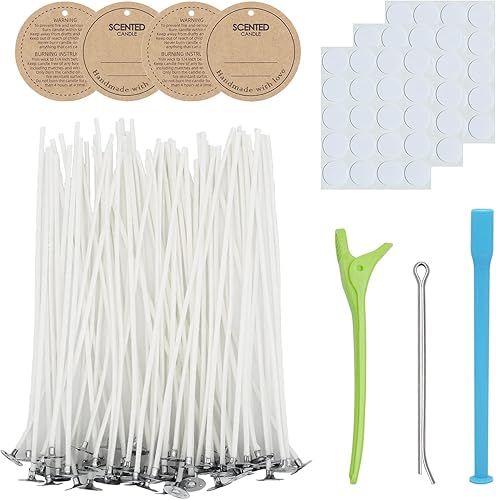
EricX Light 100 Piece Natural Candle Wick, Low Smoke 6" Pre-Waxed & 100% Natural Cotton Core,For Candle…
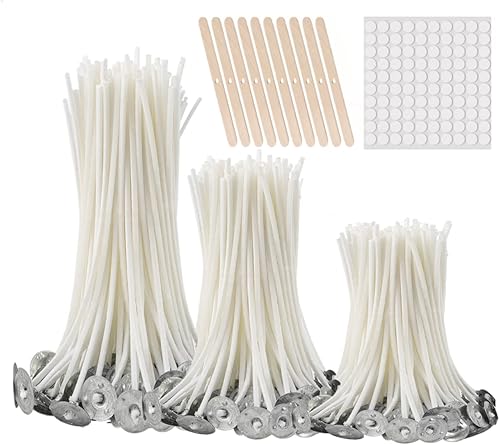
CandMak Candle Wick Kit - 60 Cotton Wicks with Candle Making Tools (Thick 4"+6"+8")
CandMak Candle Wick Kit - 60 Cotton Wicks with Tools for Making Thick, 6 inch Candles
buluker 300Pcs Functional Smokeless Candle Wicks - Pre Waxed Cotton Wick with Metal Sustainer Tabs for Pillar…
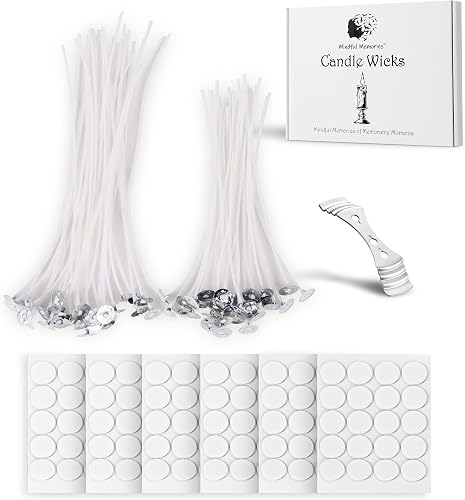
Candle Wicks 90 Pcs (4 inch, 6 inch, 8 inch) with 2 Candle Wick Holders & 90 Wick Tab Stickers, Long Lasting…

6 Inch Candle Wicks - 100 Pcs Pre-Waxed Cotton Wicks with Stickers & Holder
See more cotton candle wicks on Amazon →
CeraVelas score: combines the average rating and the number of customer reviews on Amazon.
What cotton wicks are
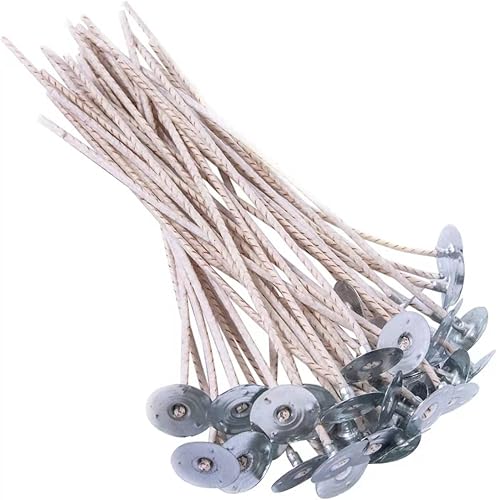
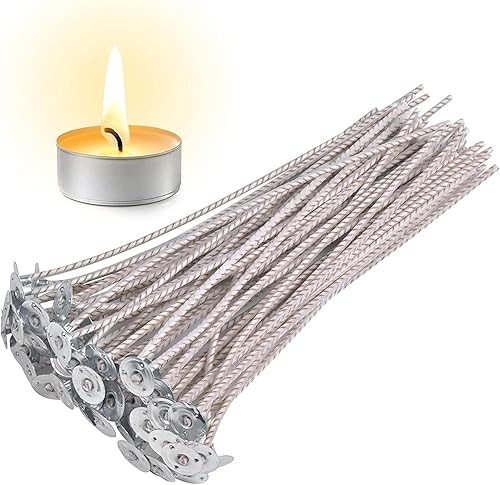
A cotton wick is a braid of cotton yarn, usually pre-waxed and crimped into a small metal tab (the sustainer). Melted wax travels up the braid by capillary action, vaporizes near the flame, and that vapor is what actually burns. That is why wick size controls how much wax is consumed, how wide the melt pool gets and, to a large extent, how much fragrance the candle throws.
You will find them in packs of 50 or 100, in lengths from about 3 to 12 inches (8–30 cm), already waxed and tabbed. They are the easiest choice for your first scented jar candles or soy candles.
Types and series
Not all cotton wicks behave the same. The braid and any reinforcing threads change a lot:
- Flat braid (ECO, CD, HTP): curls as it burns and partly trims itself. The go-to style for natural waxes. See our guides to ECO wicks and CD wicks.
- Square braid: stiffer, common in pillars and beeswax candles.
- Cored (paper or cotton core): stays upright in liquid wax; common in tealights and votives. Skip old-style zinc-core wicks if you want a more natural product.
- Generic "for soy" wicks with no series: the ones in budget packs. They work, but without a series name it is harder to repeat results.
How to choose the right size
The basic rule: wick size depends on the container diameter, the wax type and the fragrance load. Soy wax is denser and usually wants a slightly larger wick than paraffin; heavy fragrance or dye can push you a size up or down. Use the wick calculator as a starting point and always confirm with a test burn.
| Jar diameter | ECO series (soy) | CD series (soy) | Notes |
|---|---|---|---|
| 2 in (5 cm) | ECO 2 | CD 4 | Small jars and travel tins |
| 2.4 in (6 cm) | ECO 4 | CD 6 | Candles around 4–5 oz |
| 2.75 in (7 cm) | ECO 6 | CD 8 | The most common jar size |
| 3.1 in (8 cm) | ECO 8 | CD 10 | Also test one size smaller |
| 3.5–4 in (9–10 cm) | ECO 10–12 | CD 12–14 | Watch for soot and mushrooming |
| Over 4 in (10 cm) | 2 wicks | 2 wicks | Two medium wicks beat one huge one |
These are typical starting points, not hard rules: every combination of wax, fragrance and vessel burns a little differently. Length is easy, though: leave at least 1 inch (2–3 cm) above the rim so you can center the wick and trim it later.
How to use them, step by step
- Clean the bottom of the jar and secure the tab with a wick sticker or a drop of melted wax.
- Straighten the wick and hold it upright with a wick centering device.
- Pour at the temperature your wax supplier recommends and let it set without moving the jar.
- Once cured, trim the wick to about 1/4 inch (5–6 mm).
- Run a 3–4 hour test burn and check the melt pool, flame height and soot.
Common mistakes
- Guessing the wick size. Too small and the candle tunnels; too big and you get a tall flame, soot and an overheated jar.
- Skipping the trim. Trim to 1/4 inch before every burn; a wick trimmer makes it easy.
- A loose tab. If the tab lifts, the wick drifts and the flame ends up touching the glass.
- Switching fragrances without retesting. A new fragrance oil can change the ideal size.
- Leaving a candle burning unattended, especially during test burns.
To go deeper, our guide to choosing a wick walks you through reading a test burn in detail.
Pros and cons
👍 Pros
- ✓ Inexpensive and easy to find
- ✓ Huge range of series and sizes
- ✓ Steady, predictable flame when correctly sized
- ✓ Come pre-waxed and pre-tabbed, ready to use
👎 Cons
- ✗ Need trimming before every burn
- ✗ Generic packs often don’t list the series
- ✗ The wrong size causes tunneling or soot
- ✗ Need a new test burn whenever you change wax or fragrance
How to use cotton candle wicks, step by step
- Measure the inside diameter of your container.
- Pick a starting size from the chart or the calculator.
- Stick the tab to the center of the bottom.
- Center the wick with a holder before pouring.
- Pour, let it cure and trim the wick to 1/4 inch.
- Test burn and adjust the size if needed.
Tips
- Buy a variety pack with several sizes for your first tests.
- Log wax, fragrance, load and wick in a notebook so you can repeat what works.
- Torn between two sizes? Test both side by side in identical jars.
- In wide vessels, two medium wicks usually burn better than one thick one.
Projects with cotton candle wicks

Related supplies
 🏷️ Wicks Wick stickers Wick stickers are small double-sided adhesive dots that keep the wick tab stuck to the bottom of the jar while you pour your wax. See guide →
  🎯 Wicks Wick centering devices A wick centering device holds the top of the wick while the wax cools, so it sets straight and right in the middle of the jar. See guide →
  🌱 Wicks ECO wicks ECO wicks are one of the most popular series for natural wax candles: they burn clean, curl on their own and mushroom very little. See guide →
  🕯️ Wicks CD wicks CD wicks are coreless, flat-braided cotton wicks that curl as they burn. They run a little hotter than ECO wicks and perform well in both soy and paraffin. See guide →
  🪵 Wicks Wooden wicks Wooden wicks give a candle a wide, low flame and that soft fireplace crackle. They look gorgeous, but they are pickier than cotton wicks. See guide →
  🫘 Waxes Soy wax Soy wax is the go-to natural wax for container candles: creamy, beginner-friendly and known for a slow, clean burn. See guide →
 Frequently asked questions
What size cotton wick do I need for a 2.75-inch jar?
With soy wax, an ECO 6 or a CD 8 is a common starting point. Confirm with a test burn, since your fragrance and wax blend can shift the ideal size.
Do cotton wicks contain lead?
Modern cotton wicks are lead-free. Some older styles used a zinc core; if you’d rather avoid it, choose flat-braid wicks with no metal core.
Why is my candle tunneling?
Usually the wick is too small for the jar diameter or the first burn was too short. Go up one size and let the first burn melt all the way to the edges.
Can I use cotton wicks with beeswax?
Yes, but beeswax is denser and usually needs a thicker or square-braid wick. Start one or two sizes above what you would use for soy.
How long should the wick be?
When pouring, leave plenty of extra so you can center it. After curing, trim to about 1/4 inch and trim back to that length before every burn.