🛈 As an Amazon Associate, CeraVelas earns from qualifying purchases. If you buy through our links, Amazon pays us a small commission at no extra cost to you. That’s how we keep the site running. How we choose.
📑 Contents
⚡ Our top picks: wooden wicks
Stock checked on October 6, 2026

Best wooden wicks in stock
Multiwins 130 Pcs Candle Wicks for Candle Making Kit: 100 Cotton & 30 Wood Wicks with Complete Tool Set (Wick…
130 Pcs Candle Wicks for Candle Making Kit: 100 Cotton & 30 Wood Wicks with Complete Tool Set (Wick Holders…
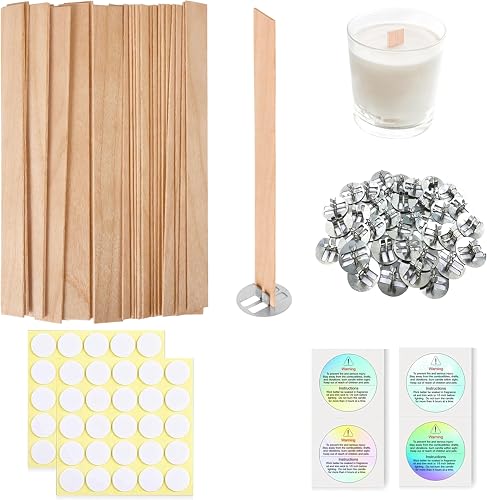
200 Pcs Thicked Wood Candle Wicks for Candle Making, 5.1 X 0.51X 0.06 Inch Upgrade Wood Wicks, Wooden Wicks…

150 Pcs Thickned Wooden Candle Wicks. 5.1 X 0.5 X 0.06 Inch Upgrade Crackling Wooden Wicks, Long Lasting…

100 Pcs Wood Candle Wicks for Candle Making-50 Wicks & 50 Wick Holders
See more wooden wicks on Amazon →
CeraVelas score: combines the average rating and the number of customer reviews on Amazon.
What wooden wicks are
A wooden wick is a thin strip of wood (cherry, maple, birch or similar), sometimes treated with a plant oil to help it draw up wax, that slides into its own metal clip. Instead of climbing a braid, liquid wax travels up through the wood fibers. The result is a horizontal flame that is wider and lower than a cotton wick’s, plus that signature crackling sound.
They perform best in coconut wax and soft blends, and they also work in soy wax, always in container candles. They are a poor match for pillars because the wide flame melts through the walls.
Types of wooden wicks
- Single: one strip of wood. The most common style and the easiest to dial in.
- Booster: a main strip with a thinner veneer attached. Helps keep the flame going in dense or heavily scented waxes.
- Double or X/cross: two strips crossed, for wide vessels.
- Spiral or curved: decorative; they burn a bit less predictably.
Every style needs its own metal clip: tabs for cotton wicks won’t work because the slot is different.
How to pick width and thickness
Two measurements matter: width (which sets the diameter of the melt pool) and thickness (which sets how much wax the wick can draw). As a rule, a wider jar needs a wider strip; denser wax or a higher fragrance load calls for a slightly thicker strip or a booster. The wick calculator gives you a wood starting point too.
| Jar diameter | Typical wick width | Notes |
|---|---|---|
| 2–2.4 in (5–6 cm) | 0.5 in (13 mm) | Small jars and tins |
| 2.75 in (7 cm) | 0.625 in (16 mm) | Try standard thickness first |
| 3.1–3.5 in (8–9 cm) | 0.75 in (19 mm) | Consider a booster with heavy fragrance |
| 4 in (10 cm) | 1 in (25 mm) | Watch that the flame doesn’t get too big |
| Over 4 in (10 cm) | 2 strips or an X wick | Space the wicks evenly |
These are typical values for soy and coconut; with paraffin a slightly narrower strip is often enough. The strip should stand taller than the rim of the jar so you can trim it later.
How to use them
- Slide the strip all the way down into its metal clip.
- Stick the clip to the center of the jar with a wick sticker.
- Keep the strip straight with a clothespin or a wick centering device; wood tends to lean as you pour.
- Pour, let the candle cure and trim the wood to about 1/8 inch (3 mm) above the wax.
- Before every burn, pinch off the charred tip or use a wick trimmer and bring it back to 1/8 inch.
Common mistakes
- Leaving the wood too long. Mistake number one: the flame drowns or smokes. With wood, shorter is better.
- Using a cotton-wick tab. The strip sits loose and wobbles.
- Picking a narrow strip for a wide jar. The candle tunnels and the flame eventually goes out in the hole.
- Burning in a draft. The wide wooden flame is more sensitive and can blacken the glass.
- Skipping the test burn. Do at least one 3–4 hour test and never leave a burning candle unattended.
If your flame keeps dying, check our guide to choosing a wick: often a shorter trim or the next thickness up fixes it.
Pros and cons
👍 Pros
- ✓ Wide, low flame that melts the surface evenly
- ✓ Much-loved crackling sound
- ✓ Natural, distinctive look
- ✓ No carbon mushrooming like cotton
👎 Cons
- ✗ Harder to dial in than cotton
- ✗ Need their own metal clips
- ✗ Go out if left too long or if the candle tunnels
- ✗ Not a good fit for pillar candles
How to use wooden wicks, step by step
- Choose the strip width based on the jar diameter.
- Slide the strip into its metal clip.
- Stick the clip to the center of the bottom.
- Hold the strip straight while you pour and while it cools.
- Trim the wood to about 1/8 inch above the wax.
- Run a 3–4 hour test burn.
Tips
- If the flame is weak, try trimming before switching sizes.
- Booster wicks help with high fragrance loads.
- Light it by tilting your lighter so the flame catches along the whole strip.
- Store wood strips somewhere dry: moisture makes them hard to light.
Projects with wooden wicks
Related supplies
 🎯 Wicks Wick centering devices A wick centering device holds the top of the wick while the wax cools, so it sets straight and right in the middle of the jar. See guide →
  🥥 Waxes Coconut wax Coconut wax is the wax behind many luxury candles: bright white, creamy and known for excellent cold and hot throw. See guide →
  🫘 Waxes Soy wax Soy wax is the go-to natural wax for container candles: creamy, beginner-friendly and known for a slow, clean burn. See guide →
  🫙 Containers Glass candle jars Empty glass candle jars are the classic home for container candles: they show off the wax, hold heat evenly and, if you pick the right glass, stay safe from the first light to the last. See guide →
  🧵 Wicks Cotton candle wicks Pre-tabbed, pre-waxed cotton wicks are where almost every homemade candle starts: inexpensive, reliable and available in dozens of sizes. See guide →
  ✂️ Tools Wick trimmer A wick trimmer is a small pair of angled scissors that reaches into jars to cut the wick to the right length, which means a cleaner flame, less soot and a longer-lasting candle. See guide →
 Frequently asked questions
Why does my wooden wick keep going out?
Almost always because it’s too long or the strip is too narrow for the jar. Trim to about 1/8 inch and, if it still struggles, try a wider strip or a booster wick.
How short should I trim a wooden wick?
About 1/8 inch (3 mm) above the wax. Before each burn, remove the black charred part so the flame can draw fresh wax.
Do wooden wicks work in beeswax?
They can, but beeswax is dense and wood struggles to draw it up. A thick cotton wick is usually the better choice.
Do wooden wicks always crackle?
Most crackle at least a little, but the sound depends on the strip thickness, the wax and the fragrance. Thinner strips tend to crackle more.
Can I use wooden wicks in pillar candles?
It’s not ideal: the wide flame tends to melt through the walls. For pillars, square-braid cotton wicks are a better bet.