🛈 As an Amazon Associate, CeraVelas earns from qualifying purchases. If you buy through our links, Amazon pays us a small commission at no extra cost to you. That’s how we keep the site running. How we choose.
📑 Contents
Color is the first thing anyone notices about a candle, and it's also one of the biggest headaches when you're starting out: shades that come out dull, white streaks on soy, little specks of undissolved dye at the bottom, or a wick that drowns after half an hour. The good news is that coloring candles isn't hard once you use the right dye and follow a couple of rules about amount and temperature. In this guide we'll cover the types of candle dye, how much to use, when to add it, and how to get anything from a dusty rose to a deep navy, plus layers and ombré effects.
Types of candle dye
Not everything that adds color belongs in a candle. The colorant has to dissolve completely in the wax. If it stays suspended, the melted wax carries those particles up into the wick, clogging it so the flame sputters or goes out. That's why candle dyes are oil-soluble and designed to burn cleanly in small amounts.
| Colorant | Pros | Cons | Best for |
|---|---|---|---|
| Dye chips or blocks | Easy to measure by weight, mess-free, consistent colors | Hard to dial in very soft shades; needs hot wax to dissolve | Container candles, pillars, repeatable batches |
| Liquid dye | Highly concentrated, mixes instantly, great for pastels | Easy to overdo; stains if spilled | Soft shades, fine-tuning, small batches |
| Mica powder | Shimmer and pearly effects | Doesn't dissolve: can clog the wick | Wax melts, pillar surface decoration |
| Crayons | You already have them | Pigments don't dissolve, unknown additives, clog the wick | Skip them for anything with a wick |
Dye chips and blocks
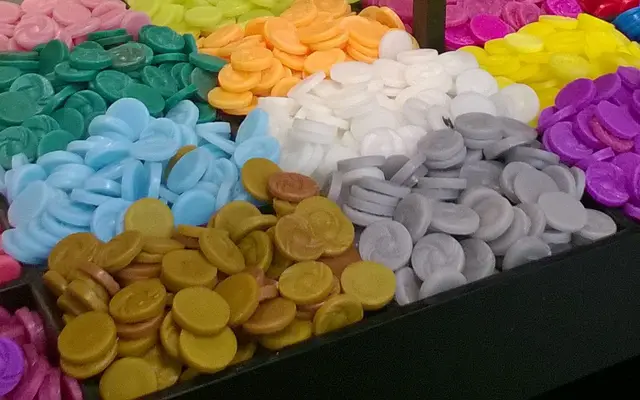
Candle dye chips are the easiest way to start. Each brand tells you how much wax one chip or block colors for a medium shade, so all you have to do is weigh your wax and follow the chart. Want a lighter shade? Shave off part of a chip with a craft knife. Want it darker? Add more a little at a time.
Liquid dye
Liquid candle dye is very concentrated: a drop or two can be enough for a small candle. It really shines for pastels and for matching an exact color, because you can count drops and write them down. Use a dropper and keep notes.
Mica: only where the wick can't reach
Mica powder is a coated mineral that adds shimmer, but it doesn't dissolve. Use it in wax melts (no wick to clog), to paint or dust the outside of a pillar candle, or on a decorative top. Stirred into a container candle, it either sinks to the bottom or ends up in the wick.
What about crayons?
It's the question we hear most. Crayons use pigments made for coloring paper, not for burning: they don't dissolve in wax, they build up on the wick, and they can make the flame smoke or die out. You also don't know what other additives they contain. For candles you'll actually light, stick to real candle dye; you'll find options in our candle dye section.
How much dye to add
There's no universal number: it depends on each brand's concentration, the type of wax, and the shade you're after. What is universal is this: always start with less. You can deepen a color, but you can't take it out without remaking the batch.
- Follow the manufacturer's chart: it tells you how much wax a chip colors or how many drops per pound they recommend for a medium shade.
- Do a color test: drip a little dyed wax onto parchment paper or a white plate and let it cool. Melted wax always looks darker and more transparent than it will once it sets.
- Log every batch: wax weight, dye brand, exact amount, and temperature. That's how you repeat a color.
- Don't overdo it: too much dye can affect how the candle burns and clog the wick. If you need a huge amount of dye to reach a shade, switch to a more concentrated product.
Keep in mind that dye, just like fragrance oil, slightly changes how a candle burns. Once you've settled on a color, always do a test burn and double-check your wick with our wick calculator.
Temperature: when to add the dye
Dye needs heat to dissolve. The usual approach is to add it once the wax is fully melted, at the upper end of your wax's working range (for many soy waxes, around 176–185 °F / 80–85 °C), and before the fragrance oil. Always check the temperatures your wax supplier recommends.
- Melt the wax in a double boiler or a pouring pitcher, never over direct heat.
- Track the temperature with a candle thermometer.
- Add the dye and stir gently for a minute or two, scraping the bottom so no chips are left undissolved.
- Do your color test on paper and adjust if needed.
- Add the fragrance oil at the recommended temperature, stir, and pour.
If you see little colored specks at the bottom of a cooled candle, the dye didn't fully dissolve: the wax was too cool or it wasn't stirred long enough.
Pastel or bold shades
Your wax makes a big difference. Natural waxes like soy wax are opaque and creamy white, so colors come out softer and more muted. Paraffin and pillar blends are more translucent and take bright, saturated colors. If you haven't picked a wax yet, check out our guide to choosing candle wax.
For pastels
- Use liquid dye or a small sliver of a chip.
- Many fragrance oils are yellowish and will push the color warmer.
- A tiny touch of brown or gray turns a loud pink into a more sophisticated dusty rose.
For bold colors
- Build up the dye gradually to the maximum the manufacturer recommends, and no further.
- With soy, you'll never get the brightness of paraffin; soy-paraffin blends or pillar waxes give more vivid results.
- Deep reds and blacks are the most demanding: they usually take a lot of dye, so keep a closer eye on the wick.
Light matters too: many dyes fade in direct sunlight. Store your candles somewhere cool and dark.
Frosting on soy candles
Frosting is that white, crystalline bloom or streaking you see on the top and sides of soy candles. It's a natural trait of vegetable wax and doesn't affect scent throw or burn, but it shows up far more on colored candles than on white ones.
- Pour at a cooler temperature, within your wax's recommended range.
- Warm your jars slightly before pouring and let candles cool away from drafts.
- Choose soy waxes with additives designed to reduce frosting, or coconut blends.
- If it's already there, a quick pass with a heat gun will improve the surface.
For other finish problems, see our candle troubleshooting guide.
Layers, ombré and other effects
Color layers
Mix each color separately. Pour the first layer and wait until it has a firm skin but is still warm. If the next layer hits wax that's too cold, the layers can separate; if it hits soft wax, the colors will bleed. Pour each new layer a little cooler than the last so you don't melt the one underneath.
Ombré
Melt all your wax, set aside an undyed portion, and add dye to the rest between pours, or go the other way: start with the darkest shade and lighten it with plain wax as you go. This works especially well for molded pillar candles.
Angled layers
Prop the container at an angle (in a box or a muffin tin) while each layer sets. It looks modern and doesn't need any extra supplies.
Shimmer with mica
For wax melts, you can stir mica straight into the wax or dust it on top. For pillars, brush it onto the outside after unmolding.
Common candle coloring mistakes
- Using food coloring: it's water-based and won't mix with wax.
- Judging the color while it's melted: always test it cooled.
- Adding dye to wax that's too cool: it stays grainy.
- Stirring mica into container candles: it clogs the wick.
- Not writing down amounts: you'll never match the shade again.
- Skipping the test burn: dye can change how the flame behaves.
Most popular projects
Frequently asked questions
Can I color candles with crayons?
It's not a good idea. Crayon pigments don't dissolve in wax, they build up on the wick, and they can make the flame smoke or go out. Use dye made for candles.
How much dye do I need for one candle?
It depends on each brand's concentration. Follow the manufacturer's chart, start with less, and do a cooled color test before you pour.
Can I use mica in container candles?
It's best not to mix it into the wax of a wicked candle, because it doesn't dissolve and can clog the wick. Use it in wax melts or on the outside of pillars.
Why does my soy candle have white streaks?
That's frosting, a natural crystallization of soy wax. Pouring cooler, warming your jars, and cooling away from drafts all help reduce it.
Does the color look the same melted and solid?
No. Melted wax looks darker and more transparent; as it cools, the shade lightens and turns opaque. That's why you should always test it cooled.